Browser Puzzle Games Worth Your Lunch Break
By IPObrains Editorial 5 min read
Free browser puzzle games grouped by the kind of thinking they demand, from matching and memory to logic, maths and spatial play.
The test of a puzzle game is not how clever its levels are. It is whether, when you fail, you can point at the exact move that did it. Games that pass that test teach you something on every attempt. Games that fail it are slot machines with a nicer vocabulary, and the browser is full of them.
Everything below passes. Each one is free, loads in a tab with nothing to install and no sign-up, and most are as playable with a thumb as with a mouse. We have sorted them by the kind of thinking they lean on, because "puzzle" covers everything from pairing cards to pushing crates, and the right pick depends on which part of your head you want to work.
Matching and spatial puzzles
Matching games are where most people start and where a lot of them stay, which is fine. The good ones are more demanding than they look.
Prism Match 3D asks you to find pairs on three-dimensional shapes, which means the tile you need is often on a face you cannot currently see. The habit worth building is to rotate first and commit second. New players grab the first pair in view and run out of easy matches by the midpoint; players who survey the whole object before touching anything last far longer.
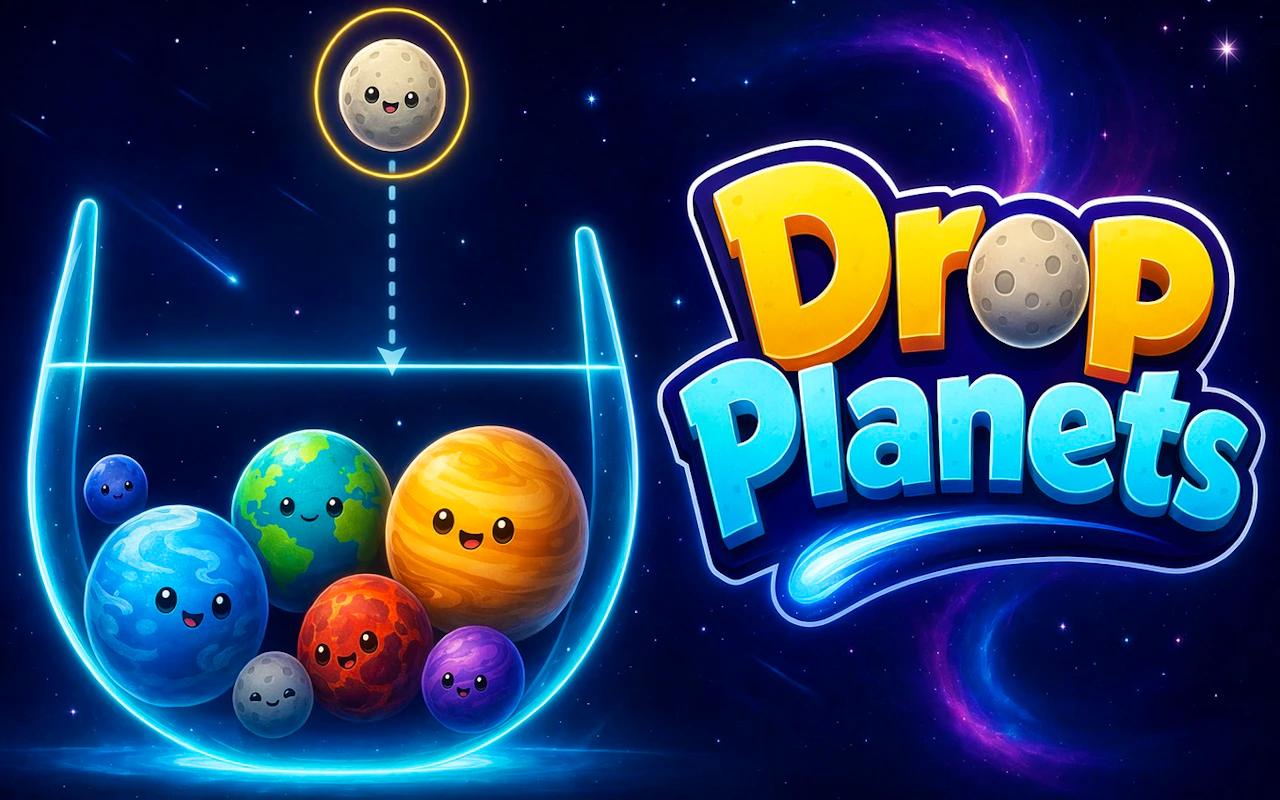
Drop Planets is a drop-and-merge game, and the mistake nearly everyone makes is treating the centre column as home. Spread your drops deliberately and keep one column clear as an escape hatch for a planet you cannot place. Think of it as Tetris with physics and fewer excuses.
Morphit and Cerkio sit at the abstract end of spatial play, where you are working with shapes rather than pictures. They suit anyone who finds matching too passive and wants something closer to geometry.
Memory puzzles
Pairs games are old, and that is a point in their favour. Memory Cards is the plain version, and plain is what you want when you are trying to improve recall rather than be entertained. Flag Memory Match adds a second layer, because remembering where the Portuguese flag is also means knowing what the Portuguese flag looks like, so you learn two things at once.
A technique that genuinely works: name the location, out loud or in your head, as you turn each card ("top left, red stripes"). Verbalising a position roughly doubles how many you can hold. Twin Peeks and Three Cups Game are quicker variations on the theme, with tracking and recall under time instead of at leisure.
The Kobadoo series is a set of short drills, each built around one kind of content. Kobadoo Emojis and Kobadoo Shapes use symbols, and Kobadoo Flags uses national flags. They are brief and repetitive on purpose, which makes them a fair place to test whether the verbalising trick is working for you.
Logic and deduction
This is the category most worth your time if you want puzzles to make you sharper at anything else.
Seat the Guests is the best introduction to constraint solving on the site. Every guest has a rule about who they will or will not sit beside, and brute force fails quickly. The method is to find the person with the fewest legal seats, place them first, then repeat. Once that approach clicks you will recognise it in sudoku, in packing a car boot, and in building a work rota.
Sokoballs takes its cue from Sokoban, and the lesson is unforgiving: a ball pushed against a wall may be stuck there for good. Work backwards from where each ball needs to finish and check which approach directions are still open. If you find yourself pushing to see what happens, you have already lost the level, you just have not been told yet.
Robot Band - Find the differences is observation rather than deduction, but it trains systematic scanning. Divide the picture into a grid in your mind and sweep it in order instead of letting your eye jump to the brightest spot.
Numbers and quick thinking
Mental arithmetic is a puzzle skill nobody admits to practising. Kobadoo Arithmetic and Kobadoo Numbers are short enough to use as a warm-up, and they are honest about what they are: drills, not entertainment. Math Fight Club adds competition to the sums, which is useful if pressure is the thing that makes your arithmetic fall apart.
Merge Royal rounds out the group. Merging identical pieces for upgrades is simple; deciding whether to merge now or wait for a bigger combination is the real puzzle, and it is a numbers question dressed as a tidying game.
Getting better rather than just playing more
Puzzle skill improves faster than almost any other kind of game skill, provided you change how you handle being stuck.
Read the entire board before the opening move. That first move is the one players throw away most often, because it feels free. It is not.
When you are stuck, back up two moves instead of one. The error is nearly always earlier than the point where you noticed it.
Use the hint if the game offers one, and use it early. A streak is worth nothing if you did not learn the pattern; a pattern learned pays off in every later level.
Switch games when you get annoyed rather than pushing through. Puzzle ability transfers between titles. Irritation does not, and it will make your next ten moves worse.
If you want the opposite kind of challenge, where there is no single right answer and you have to weigh trade-offs, our strategy games for brain training list is the next place to go. If you are playing on an older phone or laptop, most of the games here are light enough to run well, and our best games for low-end devices guide covers which to try first.
Open one from the logic section, set a ten-minute limit, and put your phone face down. Pay attention to the first move you regret. That move is your homework for tomorrow.